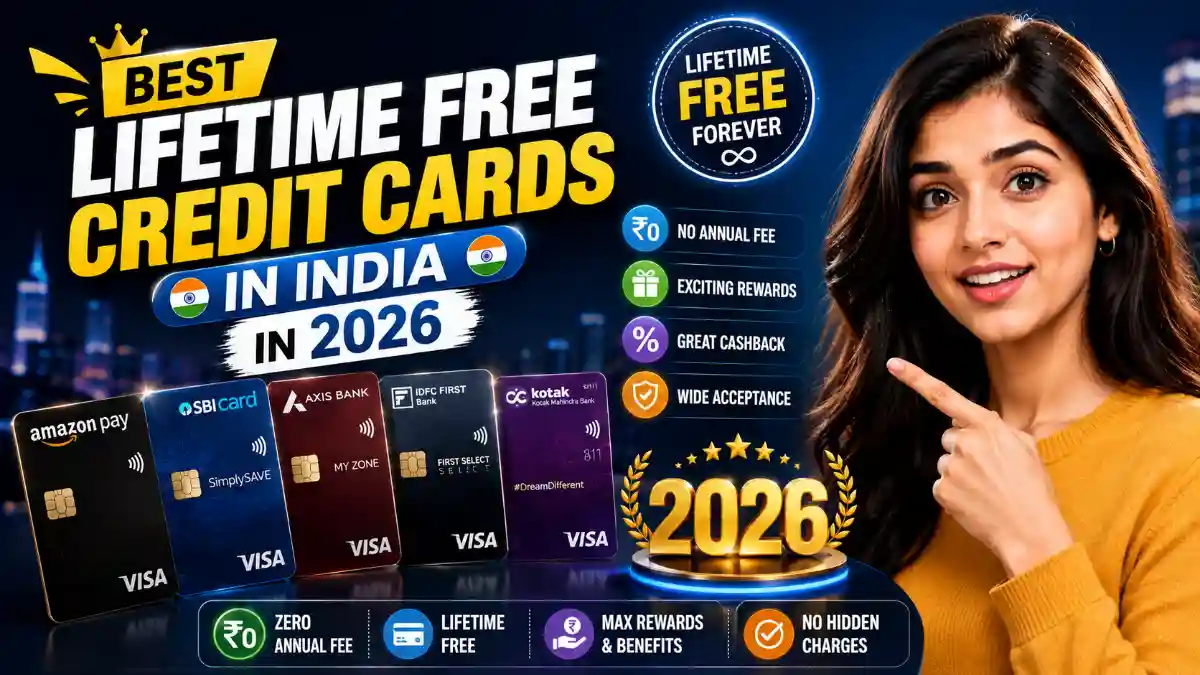
“Lifetime free” might be the most appealing two words in banking. No joining fee, no annual fee, ever. But anyone who has read a credit card agreement knows that “free” often has footnotes. The card may be free to own while still costing you in other ways.
Let’s go through what lifetime free cards offer in India in 2026, where the catches hide, and how to pick one that suits the way you spend.
What “lifetime free” really means
A lifetime free card has no joining fee and no annual or renewal fee for as long as you hold it. That’s the promise. What it doesn’t mean is that the card is free of all charges. You can still be charged for:
- Interest on unpaid balances, often 3 to 4 percent a month
- Late payment fees
- Cash advance fees
- Foreign currency markup
- Over-limit charges, where applicable
- GST on all of these
Some banks run a variation called “lifetime free with conditions”, where the fee is waived only if you spend a minimum amount yearly or make a certain number of transactions. Read it carefully. A card that needs Rs 1 lakh of spending to avoid a fee isn’t truly free.
Who should consider one
Lifetime free cards are ideal if you’re new to credit, if you spend modestly, or if you want a backup card that costs nothing to keep in a drawer. They’re also good for building credit history, since your oldest card matters for your score and a free card is easy to keep for decades.
If you spend heavily on travel or dining, you might get more value from a paid card. We cover that in our travel card guide.
Types of lifetime free cards
Cashback cards
You get a percentage of your spend back, typically 1 to 5 percent depending on the category. Online shopping often earns the highest rate, with a cap per month. They’re simple, which is why they suit beginners.
Rewards cards
These give points that you redeem for products, vouchers or statement credit. Check how much each point is worth. Redeeming for gadgets in a catalogue is usually poor value compared to cashback.
Fuel cards
Some lifetime free cards offer fuel surcharge waivers or a small cashback on fuel. If you commute daily, these can help.
UPI-enabled RuPay cards
These let you pay through UPI while using your credit limit. Worth a look if you use QR codes for most payments. See our guide to the best RuPay credit card for UPI payments.
Cards from fintech partnerships
Newer cards issued by banks in partnership with fintech apps often have instant digital approval and an app-first experience. Customer service can differ from a traditional bank, so read reviews before applying.
How to compare lifetime free cards
- Reward rate on your actual spend. Look at your last three months of statements and see where your money goes.
- Caps and exclusions. A 5 percent cashback that stops at Rs 200 a month isn’t the same as a flat 1.5 percent with no cap.
- Redemption options. Can you redeem easily, with no minimum threshold?
- Fee waiver conditions. Make sure “lifetime free” means unconditional.
- Interest and late fees. They’re similar across most banks but check.
- Customer support. You’ll need it the day something goes wrong.
Eligibility and documents
Requirements vary by bank. Generally you’ll need to be an adult resident of India with a stable income, a decent credit score (often 700 or above for mainstream cards), and standard documents: PAN, Aadhaar, address proof and income proof. Some banks give pre-approved offers to existing account holders, which usually have a higher chance of acceptance.
If you don’t have a credit history yet, our guide to first credit cards explains the starting options.
The catches to watch for
- Fees can change. Banks sometimes revise terms with notice, so a card that is free today may not remain so forever. Check your communications.
- Reward devaluation. Rates can be reduced after you’ve signed up.
- Add-on card fees. Some banks charge for extra cards.
- Dormant card closure. Not using a card at all may lead the bank to close it.
- Rent and wallet payments. Often excluded from rewards, and sometimes carry a separate fee.
Getting the most from a free card
Use it for regular spending you can predict, such as groceries, bills and subscriptions. Pay the full amount each month. Set an alert for the due date. Keep at least one small transaction going every few months so the card stays active. And resist the temptation to raise your lifestyle just because the limit is higher.
It also helps to track the reward balance. A surprising number of people let cashback sit unclaimed for years.
How to apply without getting rejected
Rejections hurt more than people realise, because every application leaves a hard enquiry on your credit report. A few habits improve your odds. Check your score before applying and fix errors in your report first. Apply to one bank at a time and wait at least three to six months between applications. Use the same address and employer details across all documents, since mismatches are a common reason for automatic rejection. And if you already have a salary account or a fixed deposit with a bank, apply there first. Banks trust customers they already know.
If you do get rejected, don’t reapply the next day. Wait, find out the reason from the bank, and work on it. Often it’s a thin credit history or an income figure just below the threshold.
Free card vs paid card: a quick example
Say you spend Rs 15,000 a month on a card, so Rs 1.8 lakh a year. A lifetime free card giving 1 percent returns Rs 1,800. A paid card with a Rs 1,000 fee and 2.5 percent returns Rs 4,500 minus Rs 1,180 (fee plus GST) which is Rs 3,320. The paid card wins, but only if you actually fit the category benefits and spend consistently. If your spending is Rs 5,000 a month, the free card wins. It’s a question of your numbers.
Reading the fine print in five minutes
You don’t need to read the whole agreement. Open the “most important terms and conditions” page, which Indian banks are required to provide, and look for the fee table, the interest rate, the reward rules, and any line that starts with “conditions apply”. Then search the document for the words “waiver” and “exclusion”. Those two words reveal what the glossy offer page leaves out.
Frequently asked questions
Is any credit card truly free?
You can avoid annual fees entirely, but interest, late fees and other charges still apply if you don’t pay on time.
Can a lifetime free card improve my credit score?
Yes, if you pay on time and keep utilisation low. The type of card doesn’t matter to the score, your behaviour does.
Should I close a lifetime free card I don’t use?
Usually not. An older account helps your credit history length. Keep it open and use it occasionally.
Are lifetime free cards easier to get?
Often yes, particularly entry-level ones, but approval still depends on your income, score and existing debt.
Do these cards have lounge access?
Most don’t, or offer very limited access tied to spending. Premium benefits usually come with fees.
This article is for general information and isn’t financial advice. Always check the latest terms on the issuer’s official website.